Characterization of the Computed Homology and Cohomology Bases
Yann-Situ Gazull, Aldo Gonzalez-Lorenzo, Alexandra Bac
Published in Proceedings of International Conference on Discrete Geometry and Mathematical Morphology, 2025
Abstract. Computing homology and cohomology is at the heart of many recent works and a key issue for topological data analysis. Among homological objects, homology generators are useful to locate or understand holes (especially for geometric objects). The present paper provides a characterization of the class of homology bases that are computed by standard algorithmic methods. The proof of this characterization relies on the Homological Discrete Vector Field, a combinatorial structure for computing homology, which encompasses several standard methods (persistent homology, tri-partitions, Smith Normal Form, discrete Morse theory). These results refine the combinatorial homology theory and provide novel ideas to gain more control over the computation of homology generators.
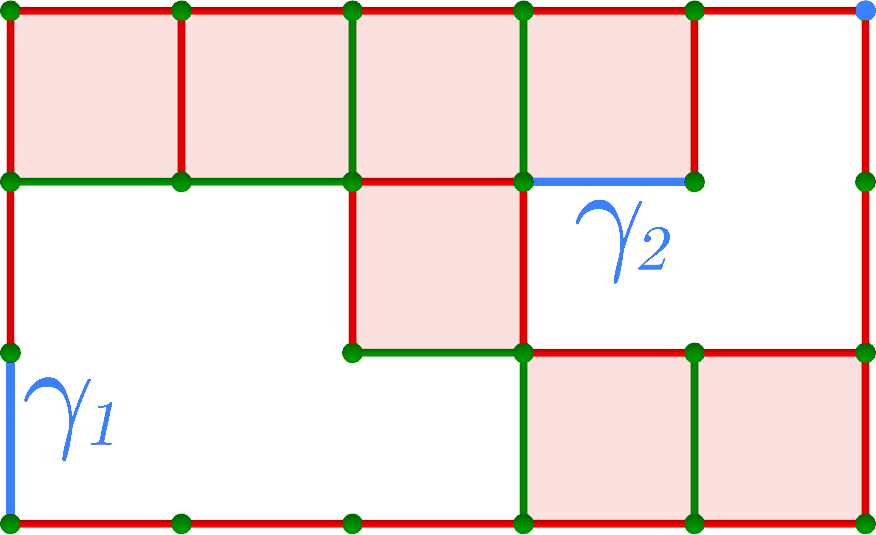
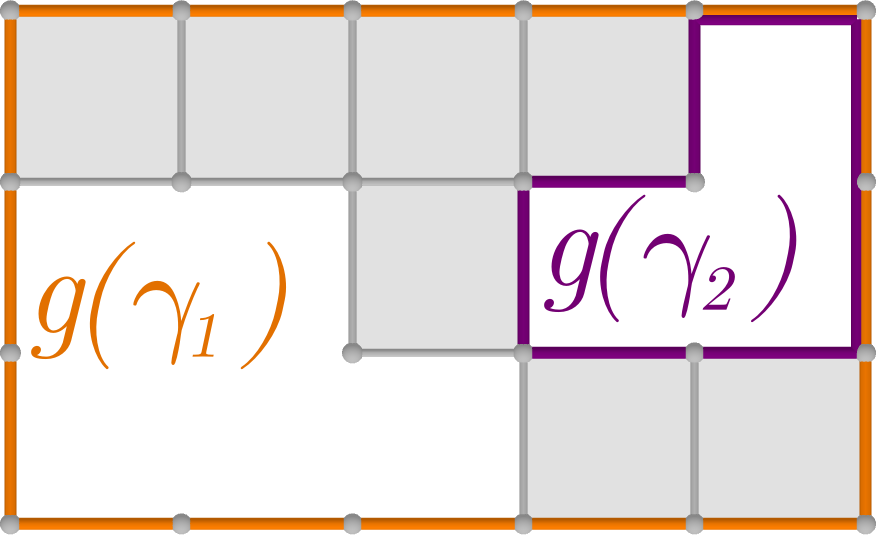
Here is an example of a 1-homology basis (right) computed by a perfect HDVF (left):
Intuitively, a \(q\)-homology basis is explicit if the two following properties are satisfied:
- no generator is included in the union of other generators;
- the complex derived from the union of all homology generators has as many \(q\)-holes as the original complex.
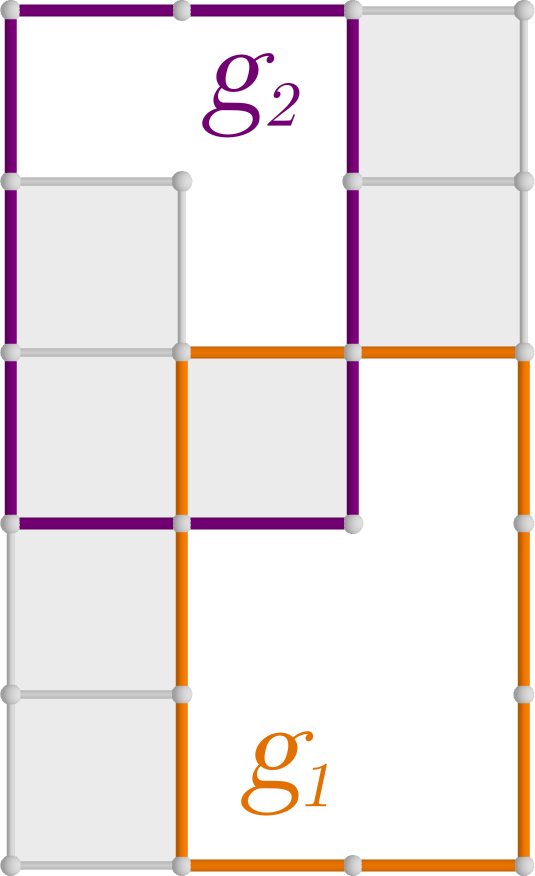
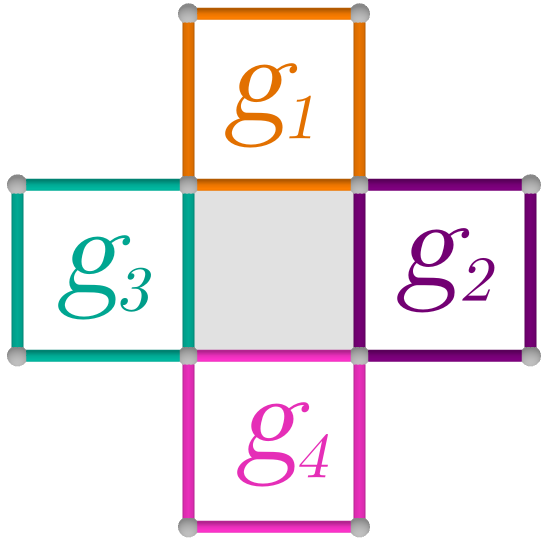
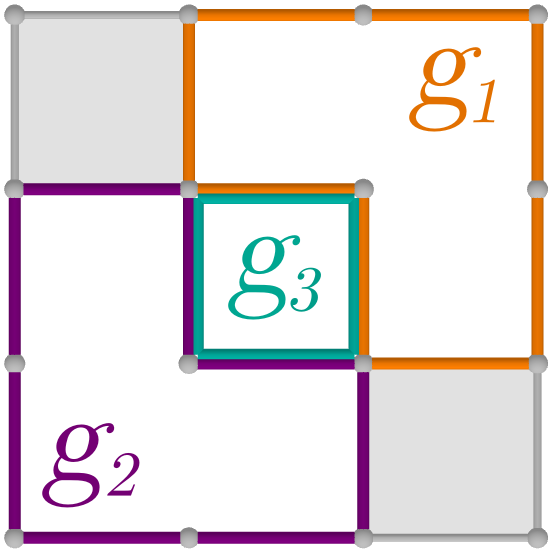
Here are examples of three non-explicit homology bases. Can you see why they are not explicit?
Yann-Situ Gazull, Aldo Gonzalez-Lorenzo, Alexandra Bac, "Characterization of the Computed Homology and Cohomology Bases." Proceedings of International Conference on Discrete Geometry and Mathematical Morphology, 2025.
Published Version | HAL Version | Bibtex