On the Graph of Homology Computations and its Connectedness
Yann-Situ Gazull, Aldo Gonzalez-Lorenzo, Alexandra Bac
Published in preprint, 2025
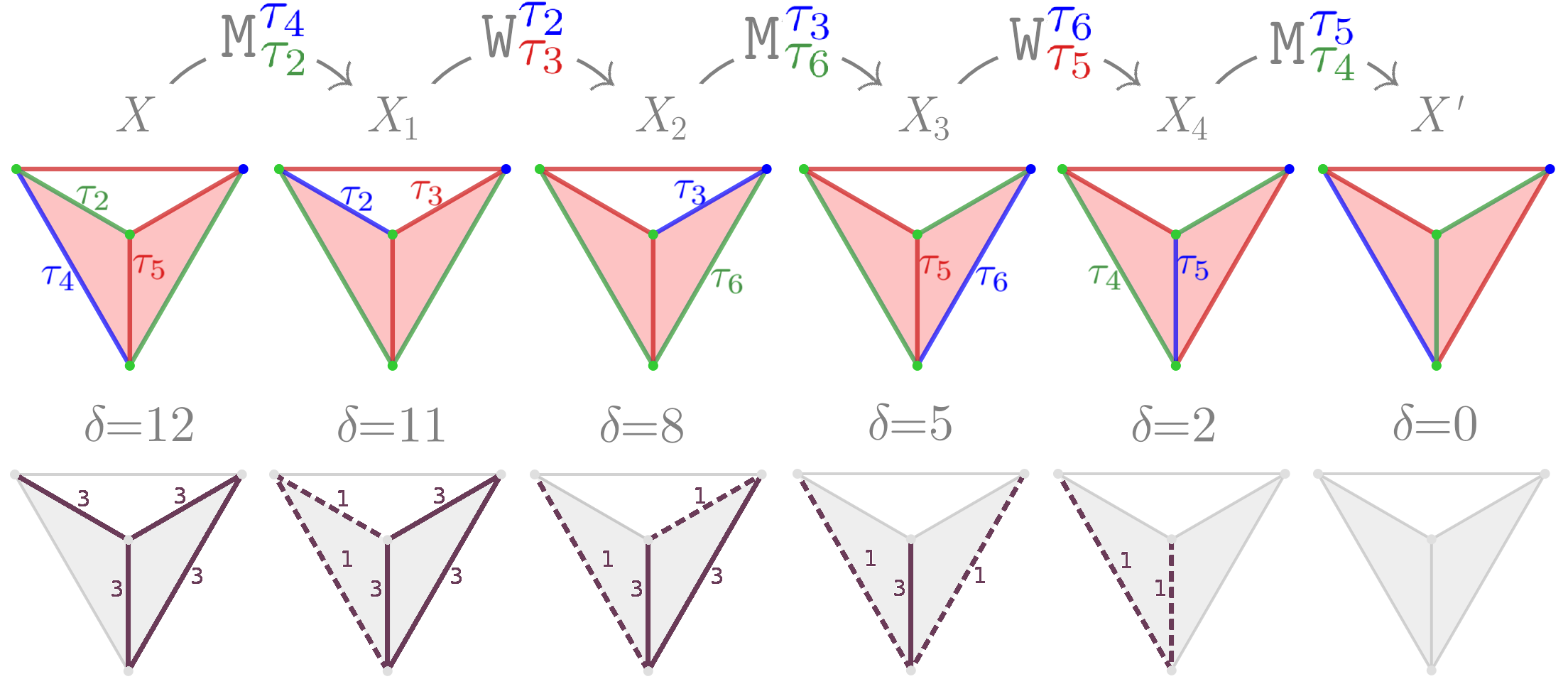
Abstract. Given a discrete object, homology and cohomology computations can be carried out through various algorithms and approaches such as Smith Normal form, discrete Morse theory, persistent homology and tri-partitions. A natural question arises: can we define operations transforming one (co)homology computation into another? And is the resulting graph of computations connected? Homological discrete vector fields (HDVF for short) are simple combinatorial structures on cellular complexes allowing the computation of (co)homology information. It has been shown that HDVFs can encode all the approaches mentioned above. Thus, HDVFs, along with a set of elementary operations, define a graph representing the space of (co)homology computations. In this paper, we investigate the structure of this graph (for (co)homology over a field) through the lens of HDVFs. We first prove that any pair of perfect HDVFs on a given complex is connected via the elementary transformations. Using similar ideas, we also provide a quadratic time algorithm that adapts a HDVF so that it contains a given (co)homology basis.
Yann-Situ Gazull, Aldo Gonzalez-Lorenzo, Alexandra Bac, "On the Graph of Homology Computations and its Connectedness." preprint, 2025.
| HAL Version | Bibtex